
Acerca de
Engineering Immunoregulatory ADSC–M2 Macrophage Hetero-Spheroids for Inflammatory Bowel Disease Therapy

Inflammatory bowel disease (IBD) is a chronic inflammatory disorder characterized by intestinal barrier disruption, immune dysregulation, and progressive tissue damage. Although mesenchymal stem cells (MSCs) and M2 macrophages have shown therapeutic potential, their clinical efficacy remains limited due to poor cell survival and insufficient immunomodulatory activity within the inflammatory microenvironment. To address these limitations, we are developing a three-dimensional hetero-spheroid platform composed of adipose-derived stem cells (ADSCs) and BMDM-derived M2 macrophages. This co-spheroid system is designed to enhance cell-cell interactions, promote anti-inflammatory cytokine secretion, and improve tissue regenerative capacity. Through synergistic immunoregulation and tissue repair, we aim to restore intestinal homeostasis and establish an effective cell-based therapeutic strategy for IBD treatment.
Development of lyophilized cancer cell vaccine

We developed a cancer cell vaccine by loading damage-associated molecular patterns (DAMPs) and pathogen-associated molecularpatterns (PAMPs) onto cancer cells through the treatment of chemotherapy and E. coli, followed by lyophilization with Cryoprotectant. The incorporation of DAMPs was verified by assessing changes in DAMP levels after chemotherapy treatment, while the optimal conditions for PAMP loading were established by evaluating the encapsulation efficiency and cell damage of cancer cell after treatment with E. coli at various MOI values.
Plant-Derived EVs for Oral Management of Obesity and Inflammatory Bowel Disease

This study aims to develop a novel therapeutic strategy for obesity and inflammatory metabolic diseases using plant-derived extracellular vesicles (EVs). Plant-derived EVs are biocompatible, naturally occurring nanovesicles that contain various bioactive cargos, including miRNAs, lipids, proteins, and phytochemicals. Owing to their low toxicity, oral applicability, and scalability, they represent a promising platform for chronic metabolic diseases that require long-term and safe treatment.After oral administration, plant-derived EVs may interact with the intestinal environment and exert systemic effects on key metabolic tissues, including adipose tissue, liver, and inflammatory gut tissues. Through these actions, plant-derived EVs are expected to reduce adipocyte hypertrophy, chronic inflammation, insulin resistance, and hepatic lipid accumulation, ultimately improving metabolic homeostasis.Therefore, this research proposes a safe, plant-based, and orally available EV platform that can overcome the limitations of conventional pharmacological treatments and provide a sustainable therapeutic approach for obesity and inflammation-associated metabolic disorders.
Curcumin-metal nanomedicine for cancer therapy

We are developing an anticancer therapy based on the natural compound curcumin. Although curcumin has been reported to exhibit a wide range of anticancer effects, its poor stability and low bioavailability have limited its clinical application. To overcome these challenges, we conjugate curcumin with metal ions to enhance its chemical stability and biological activity, and further encapsulate it into nanoparticles for targeted delivery to tumor tissues. This nanoplatform not only strengthens the induction of cancer cell death but also ensures sustained drug retention in the body and effective tumor suppression, thereby addressing the limitations of conventional therapies.
FimH expressed E.coli in situ oral administration cancer vaccine
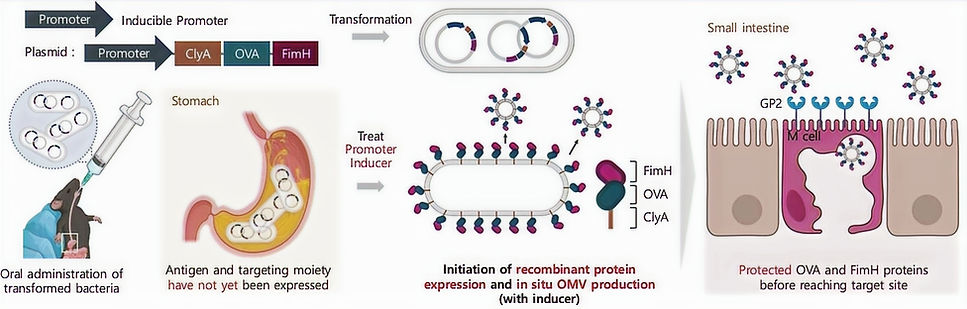
Development of an M cell–targeted oral cancer vaccine platform using engineered bacteria and an inducible expression system This study aims to develop a switch-based oral vaccine platform in which engineered bacteria are orally administered and antigen and targeting protein expression are induced at a desired time point using an external inducer. By incorporating FimH mediated M cell targeting, the platform is designed to enhance mucosal immune responses in the gut. In addition, inducible recombinant protein expression and in situ OMV production are utilized to promote effective anti-tumor immune responses and establish a next-generation oral immunotherapy strategy
FimH expressed E.coli in situ oral administration AD vaccine

Engineered bacteria expressing a ClyA–AD peptide–FimH construct are orally administered, followed by oral IPTG treatment to induce in situ OMV production in the intestinal lumen. The generated OMVs are taken up by M cells in Peyer’s patches through FimH–GP2-mediated targeting and subsequently activate dendritic cells and adaptive immune responses. This process promotes AD peptide-specific antibody production, which may cross the blood–brain barrier via FcRn-mediated transcytosis and facilitate Aβ plaque clearance through microglia-mediated phagocytosis.
Overall concept of VSP-Zn–mediated macrophage conditioning

This project proposes Zn-based VSP electrochemical stimulation as a macrophage-conditioning strategy for cirrhosis treatment. By combining Zn²⁺-mediated anti-inflammatory cues with electrochemical stimulation, VSP-Zn is expected to reprogram macrophages into a restorative-like phenotype, suppress inflammatory activation, enhance efferocytosis and MMP-mediated ECM remodeling, and ultimately promote fibrosis resolution in the cirrhotic liver microenvironment. To validate this concept, RAW264.7 cells and BMDMs will be used to evaluate macrophage phenotype, cytokine profiles, efferocytosis capacity, collagen degradation, and MMP activity. Overall, this approach may provide a novel immunomodulatory strategy to restore macrophage-mediated tissue remodeling and improve fibrotic liver disease.